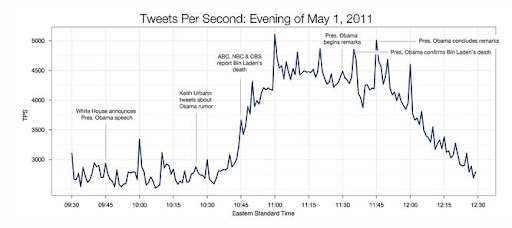

On Sunday night a group of US Navy Seals killed Osama Bin Laden. How did you hear about the news? More people than ever heard it off Twitter. The top chart above is Twitter’s activity over the course of Sunday evening. No doubt that Osama’s death caused a massive surge. If you’re lazy or hasty about coming to conclusions you might assume that this means that Twitter is replacing TV News, Newspapers, Google or whatever else happens to be the doomsday theory of the day. I think if you look closely though, you’ll find that Twitter has done nothing of the sort.  Twitter helps to amplify, accelerate and augment news; it does not replace it.
Twitter Amplifies news because it gets the word to more people. The key to the amplification is that Twitter is only 140 characters. My guess is that few people read that and thought, “good to know, time for bed.â€Â No, they went to Google or CNN or their TVs to find out more. The second graph above is Google’s searches for “Bin Laden.â€Â There are, of course, a number of extraneous data points on there (people who went to Google entirely independently of Twitter), but I think the two charts together show a trend that will lead to the next evolution in the information age. Namely, that people will follow a trail of news through their social graph and then seek (through Google or elsewhere) a reliable, more comprehensive source of information about the topic.
Twitter Accelerates news because it gets the word out in real-time. Most of us don’t watch the 24 hour news channels for more then a few minutes per day. Consequently, we hardly ever hear breaking news as it breaks. However, when news breaks we probably have a friend (or at least a friend of a friend) who happens to be watching the news. Since I am watching my Twitter account periodically all day, this means that I get the breaking news fast.
I don’t get ALL of the breaking news fast though, and this is where augmenting comes in. If the news on Monday night hadn’t been that Osama was dead, the news would have taken a very different track through the social networks.  If it had instead been that some player for Manchester United broke his shoulder, then none of my friends would have tweeted the news and I would have had no idea (which is exactly how I’d like it). Some kid in Europe who’s a big soccer fan though, he would have found out seconds after it happened because one of his friends would have been watching the game. The augmenting feature of Twitter isn’t all about filtering though, it also provides bits of the story that typical coverage avoids, but that I want to know. For example, I thought it was amusing that Obama’s speech interrupted his potential political opponent Donald Trump’s TV show. One of my friends tweeted that, but I didn’t see it anywhere else in the news and if it weren’t for Twitter I probably never would have known.
All I am saying is that in 10 years none of us will be willing to take in news that’s not amplified, accelerated and augmented by social media.
Â
Â
Â
Twitter is a website, owned and operated by Twitter Inc., which offers a social networking and microblogging service, enabling its users to send and read messages called tweets. Tweets are text-based posts of up to 140 characters displayed on the user's profile page.


0 comments:
Post a Comment